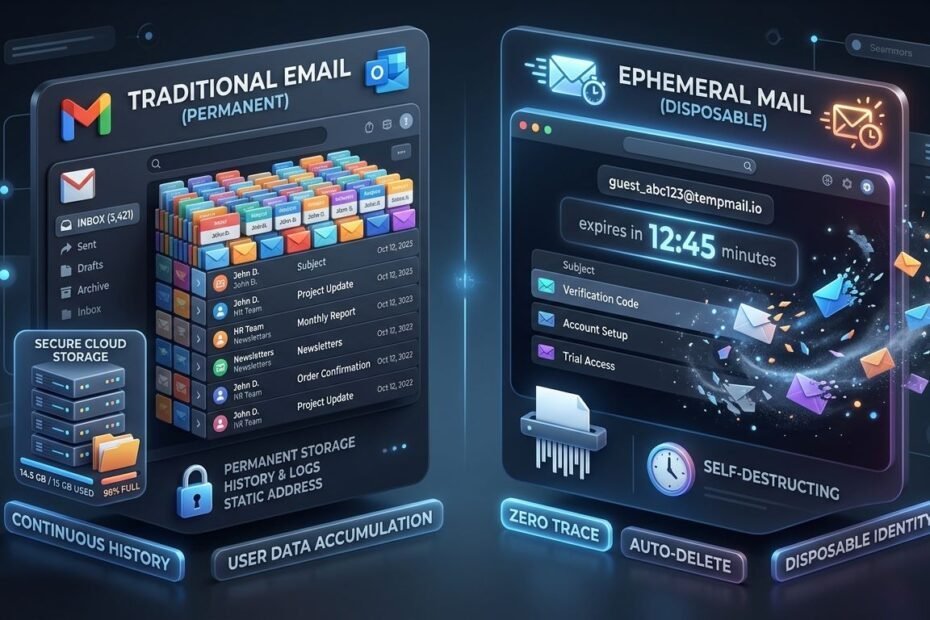
Navigating the modern web safely requires understanding when to deploy a persistent personal email address versus a free disposable temp mail inbox. While commercial webmail providers like Google Gmail, Microsoft Outlook, and Yahoo Mail are engineered for permanent communications, disposable email generators like TempMail.asia are built specifically for privacy protection, instant inbox isolation, and identity shielding.
Using the wrong type of email account in the wrong context can lead to severe consequences: exposing your primary email to lifetime spam clutter, opening your accounts to phishing vectors, or conversely, losing access to critical financial services due to an expired temporary mailbox. In this ultimate comparative guide, we analyze the architectural differences, security tradeoffs, and optimal use cases for both email paradigms.
Architectural Deep Dive: How Both Systems Operate
To understand the fundamental operational differences, we must compare the server infrastructure, data handling protocols, and identity linkages of permanent webmail versus disposable temporary mail:
1. Permanent Webmail Architecture (Gmail, Outlook, Yahoo)
Permanent webmail platforms are multi-tenant infrastructure ecosystems designed for persistent data storage and bidirectional communication:
- Identity Registration & KYC Checks: Creating an account requires providing personal data, including real names, mobile phone numbers (for SMS verification), recovery email addresses, and dates of birth.
- Persistent Database Indexing: Received and sent messages are stored permanently on solid-state drive clusters. Mail headers, search indexes, and attachment files remain stored until explicitly deleted by the account owner.
- Protocol Support: Full support for IMAP (Internet Message Access Protocol), POP3 (Post Office Protocol 3), and SMTP (Simple Mail Transfer Protocol) for sending and receiving messages globally.
- Cross-Product Tracking: Major providers link your email address to unified user accounts spanning cloud storage, mobile operating systems, browser profiles, and ad networks.
2. Disposable Temporary Mail Architecture (TempMail.asia)
Temporary email services operate on an ephemeral, privacy-first infrastructure optimized for high-speed message ingestion and automatic self-destruction:
- Zero Registration & Identity Decoupling: No personal identity details, phone numbers, or passwords are ever requested. Opening the web service instantly instantiates a dynamic email string linked to a browser session.
- Volatile In-Memory Processing: Incoming SMTP message packets land inside temporary RAM buffers without generating permanent database entries on disk.
- Automated Ephemeral Purging: All stored messages, attachments, and routing logs self-destruct automatically after session expiration or upon manual user reset.
- Receive-Only Protection: Outgoing email functionality is strictly disabled to prevent bad actors from abusing the infrastructure for spam or phishing campaigns.
Side-by-Side Feature Matrix: 10 Core Metric Breakdown
| Evaluation Metric | Permanent Webmail (Gmail/Outlook) | TempMail.asia (Disposable Mail) |
|---|---|---|
| 1. Registration Requirement | Mandatory (Phone, Name, DOB) | 100% Free & Zero Registration |
| 2. Message Storage Lifespan | Indefinite / Permanent Storage | Ephemeral (Self-Destructs) |
| 3. Tracking Pixel Defense | Vulnerable by default | Sanitized Sandbox Display |
| 4. Spam Clutter Impact | High long-term accumulation | Zero risk to main inbox |
| 5. Data Breach Risk | High exposure during third-party leaks | Zero identity exposure |
| 6. Outgoing Mail Support | Full Send & Receive Support | Receive-Only (Anti-Abuse) |
| 7. Custom Alias Support | Limited by global availability | Instant Custom Alias Generator |
| 8. Cross-Site Tracking Linkage | High (SHA-256 Email Hashes) | Zero tracking linkage |
| 9. Password Recovery Utility | Essential for persistent accounts | Inappropriate for long-term accounts |
| 10. Setup Time | 3 to 5 Minutes | Instant (0 Seconds) |
Interactive Decision Tree: Which Service Should You Use?
Follow this decision flowchart to determine whether your current online registration warrants permanent webmail or temporary disposable email:
                           [New Online Account Registration]
                                          |
                                          v
                   Is this account critical for your identity?
                   (Banking, Social Media, Tax, Work, Health)
                                   /             \
                                  /               \
                             ( YES )             ( NO )
                                /                   \
                               v                     v
                 Use PERMANENT WEBMAIL       Does it require long-term
               (Gmail, Outlook, Proton)      password recovery access?
                                                    /         \
                                                   /           \
                                              ( YES )         ( NO )
                                                 /               \
                                                v                 v
                                  Use PERMANENT WEBMAIL     Use TEMP MAIL
                                  (Or Dedicated Alias)     (TempMail.asia)
In-Depth Analysis: When to Deploy Each Solution
Scenarios Requiring Permanent Webmail:
- 1. Banking & Cryptocurrency Platforms: Online banking, brokerage portals, and crypto exchanges require persistent email addresses to deliver critical security alerts, 2FA recovery tokens, and tax reporting.
- 2. Primary Social & Professional Networks: Platforms like LinkedIn, GitHub, or Facebook rely on permanent email addresses for identity verification and account recovery.
- 3. Government, Legal & Medical Filings: Tax portals, passport applications, and electronic health record portals mandate persistent email communication for legal notices.
- 4. Employment & Corporate Communication: Official business correspondence requires domain-verified permanent email infrastructure.
Scenarios Ideal for Disposable Temp Mail:
- 1. Public Wi-Fi Authentication: Connecting to airport, hotel, or café internet portals often requires submitting an email address. Using
TempMail.asiakeeps your primary inbox safe from venue marketing spam. - 2. SaaS Software Trials & Product Demos: Evaluating online web tools or software products without consenting to lifetime promotional email sequences.
- 3. Downloading Gated Content: Accessing PDF guides, whitepapers, or research reports protected by email signup forms.
- 4. Single-Use E-Commerce Discounts: Claiming single-use promo codes without cluttering your main inbox with daily marketing mailers.
- 5. QA Software Testing: Software developers testing registration flows and automated email delivery triggers during development.
Cyber Hygiene Framework: Building a Dual-Email Strategy
Cybersecurity experts recommend implementing a **Dual-Email Strategy** to achieve high privacy and convenience:
- Tier 1 (Secure Primary Vault): Reserve a highly secured permanent email account (protected by hardware 2FA keys) strictly for financial, medical, and legal accounts. Never enter this address on public websites or forums.
- Tier 2 (Burner Isolation Layer): Use
TempMail.asiafor 100% of routine web signups, public Wi-Fi access, free trial downloads, and e-commerce coupons.
Frequently Asked Questions
What happens if I accidentally close my browser tab while using temporary mail?
As long as your browser session cookies remain intact and the mailbox lifecycle has not expired, reopening TempMail.asia will restore your session inbox.
Can I recover emails from an expired temporary mailbox?
No. Once a temporary email session expires or is manually reset, all stored messages and metadata self-destruct permanently from server memory.
Is temporary email completely legal to use?
Yes. Temporary email services are 100% legal privacy tools designed to protect personal contact information from unwanted marketing spam and data harvesting.
Conclusion
Both permanent webmail and temporary disposable mail are essential tools in modern web navigation. By reserving permanent webmail for critical accounts and using TempMail.asia for daily web signups, you maintain complete digital security, stop spam clutter, and protect your identity online.